
Welcome to the Stories page of LongDaySafaris.
Over the years, I’ve had the privilege of experiencing things that most people only hear about around a campfire or at a backyard BBQ. Friends in both South Africa and the United States often tell me I should share these stories, so this page is where I’ll start doing just that.
I’ve lived in the African bush where lions and elephants roam free, worked on dairy and cattle farms, and today I’m involved in large-scale pig production. Along the way, I’ve also cycled across parts of Africa, dealing with border crossings and the challenge of finding food and water on the road.
Here you’ll find a growing collection of real stories from the bush, the farm, and the road. Each one will link to the full story as I add them over time.
Camp fire 1:
Elephant Teasing Harry
When I was living in the Sabi Sands Game Reserve, I shared a campsite with a friend named Harry. It was a simple setup — a main house and a small cottage sitting in a clearing in the African bushveld (savanna). Nights out there were usually quiet, except for the sounds of wildlife moving through the bush.
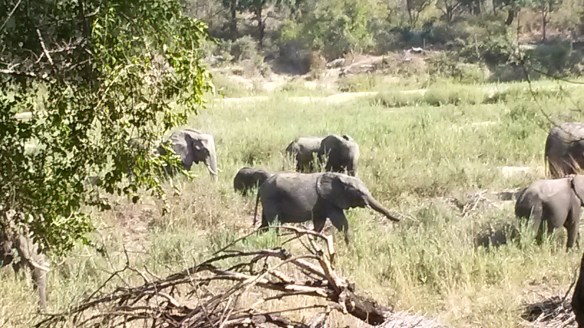
One night, though, a large bull elephant decided to pay Harry a visit. The elephant stood right in front of his house, calmly tearing apart a bush like he owned the place.
Harry wasn’t too impressed.
First, he went outside and tried to chase the elephant away. The elephant barely acknowledged him. Next, Harry came back out with a firecracker, hoping the noise would scare the big guy off.
That didn’t work either.
Between Harry’s front door and the elephant was a Toyota Land Cruiser pickup with a heavy-duty bull bar on the front. So Harry climbed into the pickup, slammed the door, honked the horn, and made as much noise as he could to try and scare the elephant away.
The elephant simply walked out into the clearing where the road comes in.
Harry drove the pickup up behind him and kept honking. It was quite a sight to watch — I was lying in my bed looking out the window at the whole thing. Honestly, if that elephant had decided to sit down, he probably would have sat right on the hood of the pickup.
The elephant slowly headed down the road and then moved into a patch of bush that sits between the entrance and exit road into the clearing. Harry circled around the bush a few times with the pickup, but he still couldn’t get the elephant to move on.
Eventually, Harry gave up and went off to bed.
The elephant, however, just stood quietly in the dark, waiting until the lights in the house went off. Then he snapped a small tree, the sound echoing through the bush. Harry rushed out again with a spotlight, but when you shine a spotlight on an elephant at night they look grey and blend right into the darkness. He couldn’t see a thing.
Luckily, my eyes had already adjusted to the dark and there was a half moon out, so I could see what was going on.
The elephant stood still for a while, and when the night sounds started filling the air again, he quietly walked through the bush to the opposite side of the house. There he waited again. Then suddenly — crack — he ripped off another branch, the sound carrying through the bushveld.
Out came Harry again with the spotlight. Still nothing. After a moment he went back inside.
The elephant stayed quiet for about ten minutes and then slowly walked around behind my cottage. At this point he was standing about five feet from my pillow. I was lying in bed watching him through the window.
Now he was in the shadow of my cottage, hidden from the main house. The big bull stood there dangling his trunk, twisting the end of it like someone turning their wrist. It was amazing how such a huge animal could be so quiet.
He slowly shifted his weight from leg to leg, waiting for the sounds of the night to build again. The cicadas were ringing loudly through the air. I could tell he was getting ready to move on.
Then he started to swagger off past my cottage. I could see the folds in his skin and his tail swaying with each step. As he passed the big jackalberry tree in front of my place, he ripped off a large branch and kept walking.
He crossed the dry sandy riverbed and disappeared into the night.
Not long after, Harry came out again with his spotlight.
That elephant bull definitely had a sense of humor — he was just teasing Harry. The bull knew him well. He had been visiting that campsite for years. And when the lemon tree is full, he comes in and strips the leaves and lemons off in one wrap of his trunk.
Camp fire 2:
Cycling in Africa: A Night Ride and Village Welcome in Mozambique
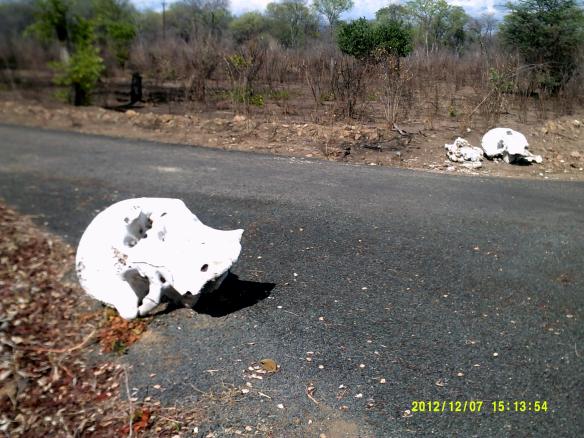
I was riding my bicycle through the African savannah as the sun hit the horizon when a thought hit me that made the road ahead feel a lot longer — my small headlamp wasn’t strong enough to spot elephants in time if they were standing on the road. Earlier that day I had already passed two elephant skulls and several piles of dung. Now the night was closing in fast.
Long-distance cycling in Africa always comes with a sense of adventure and the unexpected. While riding my bicycle from Mague to Estima in Mozambique, I experienced one of those nights that perfectly captures what bicycle touring across Africa can be like.
The road stretched out in front of me — a good tar road cutting through the wide African savannah. But I was starting to worry about where I would camp for the night.
This region had once been part of the Mozambican civil war, and I knew landmines had been planted in areas not far from the road. Camping randomly along the roadside didn’t feel like a good idea.
Cycling into the African Night
The sun slowly dipped below the horizon and soon disappeared completely. One by one the stars came out, leaving me riding through the savannah with only a small head headlamp lighting the way.
From past experience cycling in Africa, I knew that light wouldn’t give me enough time to identify elephants on the road ahead. At night, elephants often blend into the darkness. With a spotlight they simply look like part of the night itself.
That meant there was a real possibility of riding straight into a herd before realizing what was happening — something no cyclist wants to experience.
Finding a Village in Mozambique
Around 8 p.m., I finally came across a small tribal village and decided to stop and ask if I could camp there for the night.
As I stopped, I promptly fell off my bicycle when my cleat refused to disengage — not the most impressive entrance into the village.
An older man saw the whole thing. We tried to communicate, but neither of us understood the other. He called over a younger man who, fortunately for me, had spent time working in Zimbabwe and spoke some English.
I explained that I was cycling across Mozambique and asked if I could camp in the village.
The answer was respectful but not simple.
They told me they didn’t have permission to allow it. I would need to speak to the night watch — the man responsible for keeping elephants out of the farmland at night.
Asking the Village Elder
We found the night watch, and after listening to my story he explained that he also didn’t have the authority to allow it. Only the village elder could make that decision.
So we walked to the elder’s house.
He wasn’t there at the time and was visiting somewhere else in the village, so we waited outside. About fifteen minutes later he returned.
When he arrived, my translator bowed down, making sure his head stayed lower than the elder’s chin — a sign of respect still practiced in the village. Seeing that in today’s modern world was fascinating, and I wasn’t quite sure if I should be doing the same.
The elder listened carefully to my story about cycling across Africa and looking for a safe place to camp.
Then he smiled and immediately offered a place right beside his house.
Camping in an African Village
I thanked him and set up my tent near his home. The elder then asked through the translator if I needed food. I told him I had brought some with me, so I cooked a simple meal of instant noodles.
Later that evening I sat under the trees near his house where several elders of the village were gathered talking quietly in the dark. I didn’t understand their language, but it was still a special moment to sit there and share the night air with them.
Eventually I excused myself and crawled into my tent. Not knowing how safe my bicycle would be, I pulled it inside the tent with me — which made for a tight fit in a two-man tent.
Sunrise in the Village
Just before sunrise the roosters began crowing and the village slowly came alive with the sounds of morning.
I packed my gear back onto the bicycle and waited for my translator, who had said he would come by in the morning.
Soon the elder stepped out of his house. I asked the translator to thank him again for his hospitality. Once again, the young man bowed respectfully as he spoke.
Then I climbed onto my bicycle and rode out of the village as the sun rose like a glowing ball on the horizon.
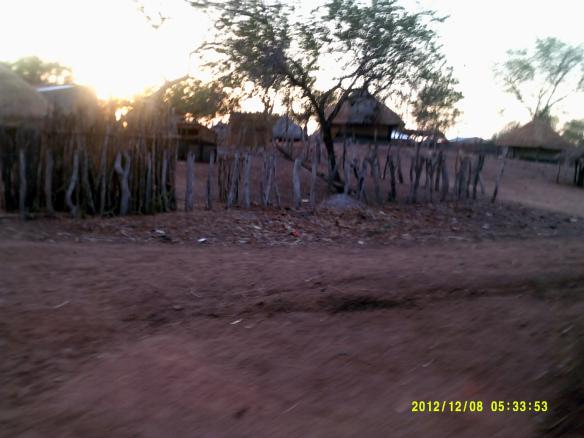
In the daylight I could finally see the village clearly — round mud houses with thatched roofs, dusty ground with chickens wandering everywhere, and the African savannah stretching beyond it.
And just like that, my Mozambique cycling adventure continued down the road toward Estima.
 Long day safaris