Unknown's avatar

About krfarmer

I am a cyclist that enjoys getting out and seeing the African nature.

Meditation on Two Wheels: Finding Peace Through Cycling


There’s a lot of talk these days about meditation, mindfulness, and finding peace.

For some, that means sitting still in a quiet room.
For me, it’s something very different.

It’s getting on a bike and riding.

The Ride That Clears More Than the Road

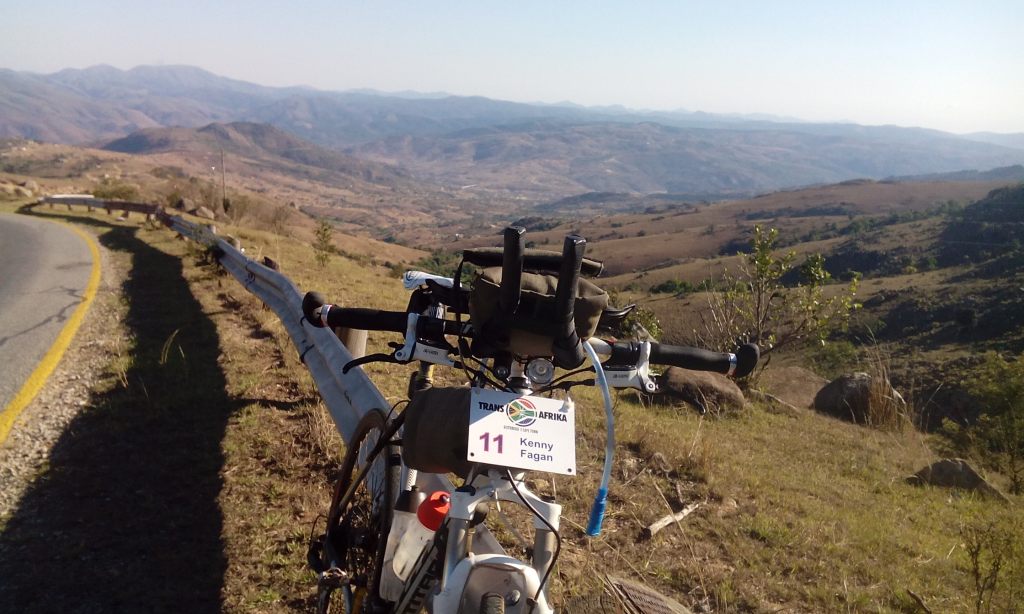
I’ve found that the longer the ride, the quieter my mind becomes.

Out on the road, away from the noise of work and daily life, something shifts. The constant pressure, the decisions, the stress—they start to fade. What replaces them isn’t emptiness, but clarity.

What started as just a ride has turned into something more. Something I didn’t expect.

A form of meditation.


Pushing Beyond What I Thought Was Possible

One of the biggest surprises has been discovering that my physical limits weren’t where I thought they were.

There have been moments on long rides where everything in me said to stop. Legs burning. Mind doubting. Comfort zone long gone.

But pushing through those moments changed something.

It showed me that most limits aren’t real—they’re just lines we draw for ourselves.

And once you step past them, even just a little, it opens the door to a different way of thinking:

I can do more.
I can handle more.
I’m capable of more than I thought.

Time Alone Builds Strength

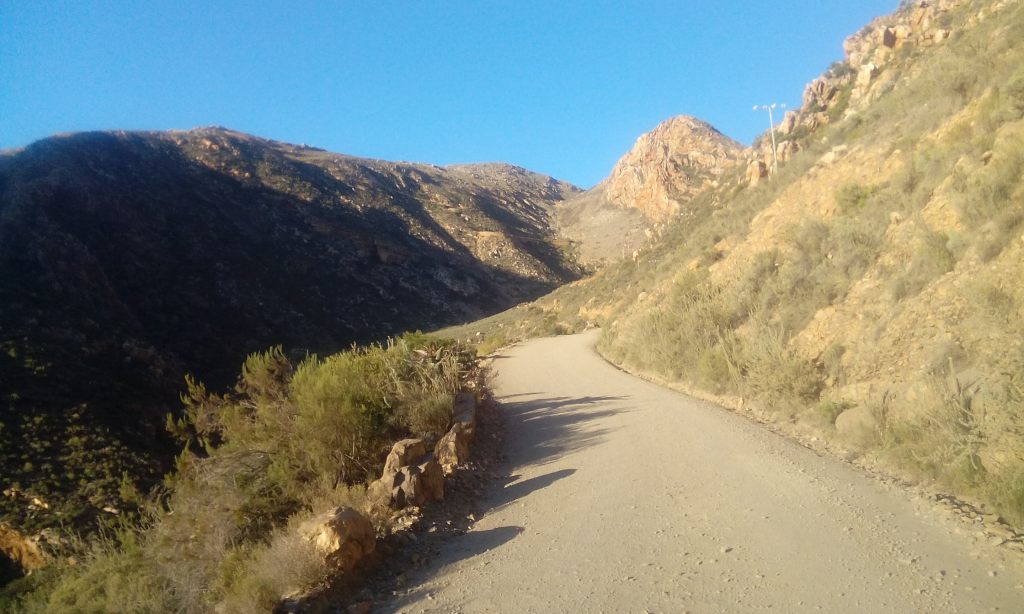
There’s something powerful about being alone with your thoughts for hours at a time.

No distractions. No noise. Just you and the road.

That time has helped me work through things I didn’t even realize were weighing on me. It’s where problems get sorted out, ideas come together, and perspective returns.

It’s also where a quiet kind of confidence starts to build.

Not loud. Not showy.
Just steady.


When Everything Comes Back Into Perspective

Life has a way of piling things on—work stress, daily challenges, responsibilities.

But I’ve noticed something.

No matter how heavy things feel, when I go for a ride, it changes.

Somewhere along the road, things begin to make sense again. Problems don’t always disappear, but they shrink. They become manageable.

You realize what matters—and what doesn’t.
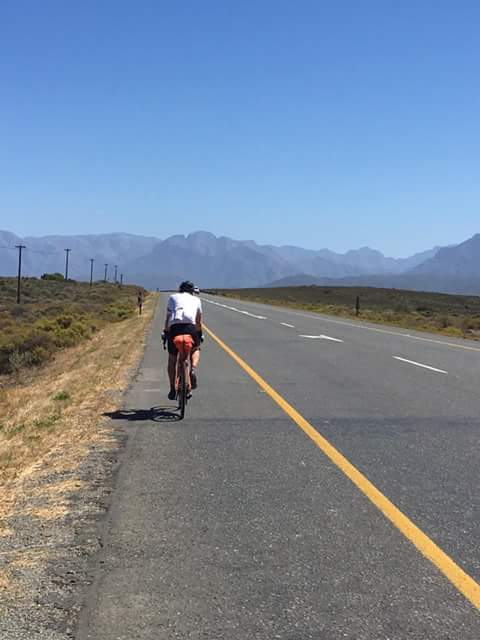

Losing Yourself to Find Yourself

There’s also something about being out in the world—seeing the landscape, the open space, the movement—that takes your focus off yourself.

And strangely, that’s where you find something deeper.

When you stop thinking so much about yourself, you start seeing things more clearly.

You gain perspective.


My Version of Meditation

I wouldn’t have called it meditation at first.

But that’s exactly what it is.

Not sitting still—but moving forward.
Not silence—but rhythm.
Not escape—but clarity.

It’s where I find peace.
It’s where I reset.
It’s where I remember what I’m capable of.


Final Thought

You don’t have to follow someone else’s version of meditation.

Sometimes, it’s not about sitting still at all.

Sometimes, it’s about getting out, pushing yourself, and giving your mind the space it needs to breathe.

For me, that space is found on two wheels.


🚴‍♂️ Live the Mindset

If this resonates with you, I’ve created designs inspired by this exact mindset—pushing limits, hard work, and finding freedom in the process.

👉 Check out my gear on TikTok
👉 Follow the journey at Longdaysafaris.com
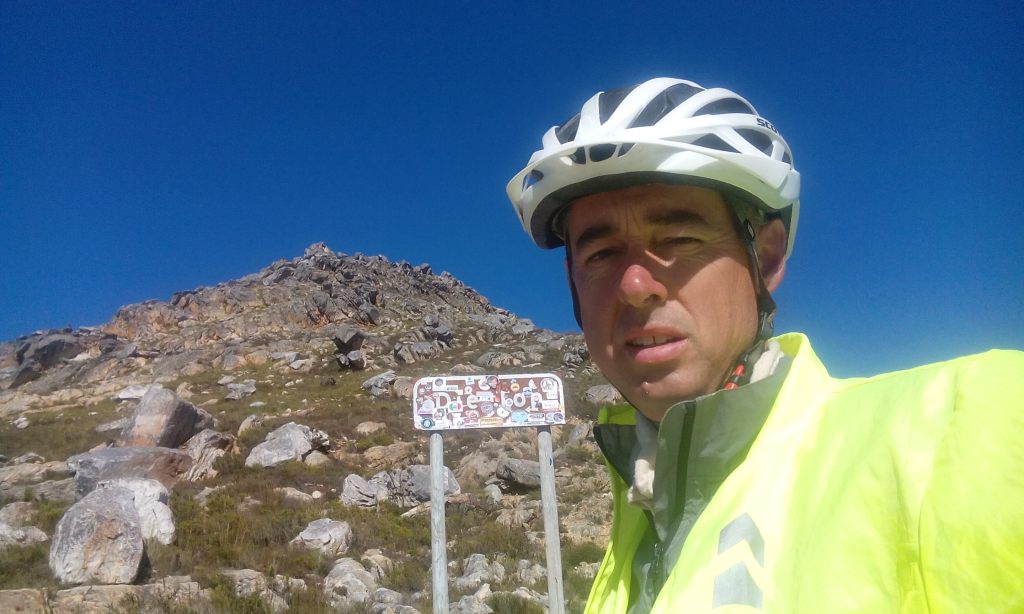

Time to get back on my bicycle.

youtube.com/shorts/UeaTTd0k_U0

Mangrove midge in Mozambique. (posted on Camp fire stories page)

Cycling in Africa: A Night Ride and Village Welcome in Mozambique

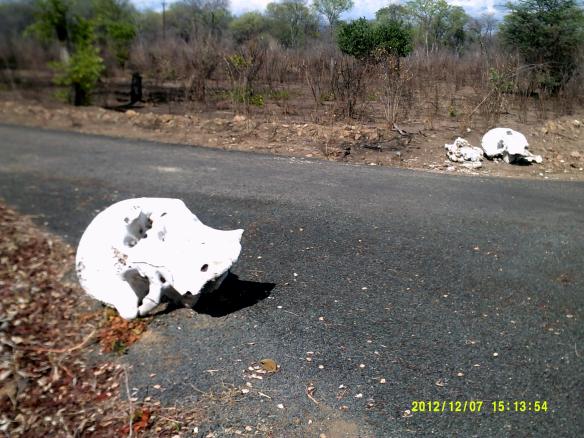
I was riding my bicycle through the African savannah as the sun hit the horizon when a thought hit me that made the road ahead feel a lot longer — my small headlamp wasn’t strong enough to spot elephants in time if they were standing on the road. Earlier that day I had already passed two elephant skulls and several piles of dung. Now the night was closing in fast.

Elephant skulls

Long-distance cycling in Africa always comes with a sense of adventure and the unexpected. While riding my bicycle from Mague to Estima in Mozambique, I experienced one of those nights that perfectly captures what bicycle touring across Africa can be like.

The road stretched out in front of me — a good tar road cutting through the wide African savannah. But I was starting to worry about where I would camp for the night.

This region had once been part of the Mozambican civil war, and I knew landmines had been planted in areas not far from the road. Camping randomly along the roadside didn’t feel like a good idea.

Cycling into the African Night

The sun slowly dipped below the horizon and soon disappeared completely. One by one the stars came out, leaving me riding through the savannah with only a small head headlamp lighting the way.

From past experience cycling in Africa, I knew that light wouldn’t give me enough time to identify elephants on the road ahead. At night, elephants often blend into the darkness. With a spotlight they simply look like part of the night itself.

That meant there was a real possibility of riding straight into a herd before realizing what was happening — something no cyclist wants to experience.

Finding a Village in Mozambique

Around 8 p.m., I finally came across a small tribal village and decided to stop and ask if I could camp there for the night.

As I stopped, I promptly fell off my bicycle when my cleat refused to disengage — not the most impressive entrance into the village.

An older man saw the whole thing. We tried to communicate, but neither of us understood the other. He called over a younger man who, fortunately for me, had spent time working in Zimbabwe and spoke some English.

I explained that I was cycling across Mozambique and asked if I could camp in the village.

The answer was respectful but not simple.

They told me they didn’t have permission to allow it. I would need to speak to the night watch — the man responsible for keeping elephants out of the farmland at night.

Asking the Village Elder

We found the night watch, and after listening to my story he explained that he also didn’t have the authority to allow it. Only the village elder could make that decision.

So we walked to the elder’s house.

He wasn’t there at the time and was visiting somewhere else in the village, so we waited outside. About fifteen minutes later he returned.

When he arrived, my translator bowed down, making sure his head stayed lower than the elder’s chin — a sign of respect still practiced in the village. Seeing that in today’s modern world was fascinating, and I wasn’t quite sure if I should be doing the same.

The elder listened carefully to my story about cycling across Africa and looking for a safe place to camp.

Then he smiled and immediately offered a place right beside his house.

Camping in an African Village

I thanked him and set up my tent near his home. The elder then asked through the translator if I needed food. I told him I had brought some with me, so I cooked a simple meal of instant noodles.

Later that evening I sat under the trees near his house where several elders of the village were gathered talking quietly in the dark. I didn’t understand their language, but it was still a special moment to sit there and share the night air with them.

Eventually I excused myself and crawled into my tent. Not knowing how safe my bicycle would be, I pulled it inside the tent with me — which made for a tight fit in a two-man tent.

Sunrise in the Village

Just before sunrise the roosters began crowing and the village slowly came alive with the sounds of morning.

I packed my gear back onto the bicycle and waited for my translator, who had said he would come by in the morning.

Soon the elder stepped out of his house. I asked the translator to thank him again for his hospitality. Once again, the young man bowed respectfully as he spoke.

Then I climbed onto my bicycle and rode out of the village as the sun rose like a glowing ball on the horizon.

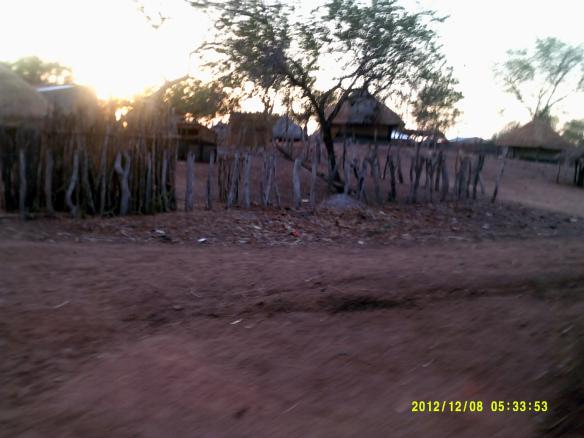
In the daylight I could finally see the village clearly — round mud houses with thatched roofs, dusty ground with chickens wandering everywhere, and the African savannah stretching beyond it.

And just like that, my Mozambique cycling adventure continued down the road toward Estima.

Sun rise village

Elephant Teasing Harry

When I was living in the Sabi Sands Game Reserve, I shared a campsite with a friend named Harry. It was a simple setup — a main house and a small cottage sitting in a clearing in the African bushveld (savanna). Nights out there were usually quiet, except for the sounds of wildlife moving through the bush.

One night, though, a large bull elephant decided to pay Harry a visit. The elephant stood right in front of his house, calmly tearing apart a bush like he owned the place.

Harry wasn’t too impressed.

First, he went outside and tried to chase the elephant away. The elephant barely acknowledged him. Next, Harry came back out with a firecracker, hoping the noise would scare the big guy off.

That didn’t work either.

Between Harry’s front door and the elephant was a Toyota Land Cruiser pickup with a heavy-duty bull bar on the front. So Harry climbed into the pickup, slammed the door, honked the horn, and made as much noise as he could to try and scare the elephant away.

The elephant simply walked out into the clearing where the road comes in.

Harry drove the pickup up behind him and kept honking. It was quite a sight to watch — I was lying in my bed looking out the window at the whole thing. Honestly, if that elephant had decided to sit down, he probably would have sat right on the hood of the pickup.

The elephant slowly headed down the road and then moved into a patch of bush that sits between the entrance and exit road into the clearing. Harry circled around the bush a few times with the pickup, but he still couldn’t get the elephant to move on.

Eventually, Harry gave up and went off to bed.

The elephant, however, just stood quietly in the dark, waiting until the lights in the house went off. Then he snapped a small tree, the sound echoing through the bush. Harry rushed out again with a spotlight, but when you shine a spotlight on an elephant at night they look grey and blend right into the darkness. He couldn’t see a thing.

Luckily, my eyes had already adjusted to the dark and there was a half moon out, so I could see what was going on.

The elephant stood still for a while, and when the night sounds started filling the air again, he quietly walked through the bush to the opposite side of the house. There he waited again. Then suddenly — crack — he ripped off another branch, the sound carrying through the bushveld.

Out came Harry again with the spotlight. Still nothing. After a moment he went back inside.

The elephant stayed quiet for about ten minutes and then slowly walked around behind my cottage. At this point he was standing about five feet from my pillow. I was lying in bed watching him through the window.

Now he was in the shadow of my cottage, hidden from the main house. The big bull stood there dangling his trunk, twisting the end of it like someone turning their wrist. It was amazing how such a huge animal could be so quiet.

He slowly shifted his weight from leg to leg, waiting for the sounds of the night to build again. The cicadas were ringing loudly through the air. I could tell he was getting ready to move on.

Then he started to swagger off past my cottage. I could see the folds in his skin and his tail swaying with each step. As he passed the big jackalberry tree in front of my place, he ripped off a large branch and kept walking.

He crossed the dry sandy riverbed and disappeared into the night.

Not long after, Harry came out again with his spotlight.

That elephant bull definitely had a sense of humor — he was just teasing Harry. The bull knew him well. He had been visiting that campsite for years. And when the lemon tree is full, he comes in and strips the leaves and lemons off in one wrap of his trunk.

KJKJ$

Growing the LongDaySafaris Community on TikTok

Over the past few months I’ve been thinking about how to grow the longdaysafaris.com community and share more of the things I’m passionate about. So I’ve made a few changes that I’d like to share with you.

First, I’ve launched a TikTok account as well as a TikTok Seller account on TikTok. The goal is to create short videos related to the things many of us enjoy—travel, cycling, farming life, and the occasional story from the road.

Alongside the videos, I’ve also started putting items up for sale through the platform. At the moment, I’m beginning with print-on-demand T-shirts, some of which are inspired by farming life and cycling culture. These are two passions of mine, and it seemed like a natural place to start. Here are two links to my first print on demanad T-shirts. At this stage they are only available on tikTok in the USA:

Cycle tourist https://www.tiktok.com/t/ZP9Re7MN8rkpq-oMMyB/

Freedom cycling https://www.tiktok.com/t/ZP9Re7wUaXj4F-uzRFe/

Over time I plan to expand into other items and ideas related to:

  • Farming and livestock life
  • Bicycle touring and long-distance cycling
  • Travel and safari experiences
  • Practical gear and products connected to these lifestyles

Another interesting development has been the impact on this blog. Since setting up the TikTok accounts, the traffic to LongDaySafaris has more than doubled. That tells me there is real interest out there, and it has motivated me to begin posting more regularly again.

But I’d like this site to grow with the help of the people who read it.

I’d love your feedback

What topics would you like me to write about?

Some ideas might include:

  • Bicycle touring routes and tips
  • Stories and experiences from African travel
  • Farming life and livestock production
  • Preparing for international travel
  • Advice for first-time visitors to Africa

If there’s something you’d like to know more about, feel free to leave a comment or send me a message. Your feedback will help guide future posts.

A New Perspective

Another change in my life is that I now live in the United States. That has given me a different perspective on travel and logistics, especially for people planning trips abroad. Because of this, I hope I can be even more helpful to international travelers planning trips to Africa—whether it’s understanding the realities of travel, preparing properly, or simply knowing what to expect.

LongDaySafaris started as a place to share experiences from the road. Going forward, I hope it becomes even more of a community for people interested in adventure, cycling, farming life, and travel.

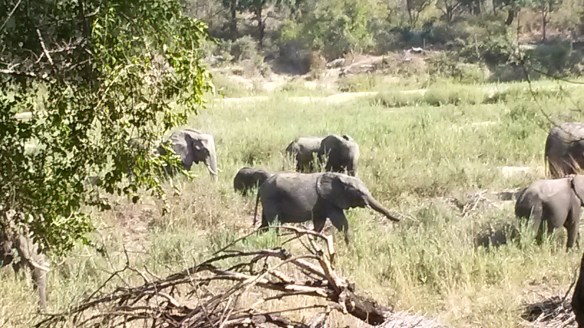
Thanks for reading and for being part of the journey. Here are a few photos to wet your thirst.

Bicycle finally arrived

I am back. This blog was written along time back. I did not get to post it. On reading the post I felt it worth posting, to give a new cold weather cyclist point of view. I have also since got a new laptop making it possible to start posting again.

After packing bicycle into a box in South Africa to send it with my household items. It took from April 2021 to February 2022 to get to me in the United States. This was due to a few things. First was we could not afford to hire a full container so we had to wait for a shared container to get full. COVID 19 had a slow down on immigration as they stopped visa interviews for a few months. There was the strike/rampage /destruction of property when Jacob Zuma (ex president of South Africa) was put into prison for contempt of court. Then there was the labor shortages at harbors to off load in the United states. The relocation company that did not have the paper work right for customs and then a supposed hold on our goods by I do not know who.

Bike build

Our boxes arrived on a cold February morning with a wind chili of -25 degrees Celsius. At that stage my garage with a heater felt too cold to assemble the bike for another week. When I finally got it together a week later, I went out but found there were to many ice patches to even try test ride the bike. I will have to plan to change tires for the winter.

Learn cold weather adaptions

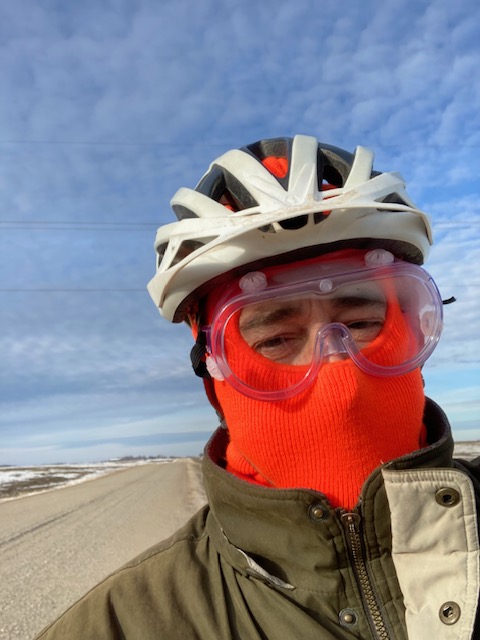
Then another week later I went to town and got a head covering and goggles so that when I breath the glasses do not mist up. You cannot ride with ordinary glasses as your eyeballs freeze.

Bike repairs

Then there was a warmer Saturday where the temp was only -5C and wind had slowed down to 25 mph. Only to discover the gears did not want to change. First, I thought it was that the chain lube had frozen the chain and gears. Think that was part of it but the main reason was that the gear shifter spring had broken for moving the back derailer. Front derailer must have been frozen.

I decided to purchase a new set of shifters on eBay. I knew that the shifter was on their way out already in South Africa. With the cost of immigration, I had decided to delay the purchase. I decided to stay with Shimano leavers and not the high end of the range. Much to my disappointment when they arrived a few days later they did not even have Shimano written on them. I am not too sure how long they will last but they will get me going. They may even surprise me. I am not sure that I would trust them on the Tour Divide route.

Lessons learned

On my third ride I thought it was warming up. So, I did a part gravel and part hard top ride. Was a round trip of 9 miles(note I have changed my GPS from km to miles). The temperatures were just above freezing. This time I did not wear my jacket and snow pants. When I got home and changed I found that I had mild frost bite around my hips were the wind speeds up to go around your waist. So I must remember if the temperature is warmer than freezing the wind chili must be considered. Layering is also important as having extra layers can break the wind speed. Only problem breaking the wind with a wind breaker can cause you to sweat too much so that you feel like you are in a swimming pool.

Well, will catch up more on the next blog.

Living in a new world

I have enjoyed my time discovering Africa on my bicycle. However that chapter has come to an end in my life. I named my blog Long Day Safaris as the bicycle gave me long days to look and dream in Africa. Most people think of safaris as trips into wild Africa. This was true for many days on the bicycle. Like my first tour in Mozambique. The night I had to stop ridding and look for a village to pitch my tent. As I was afraid I might ride into a herd of elephant in the dark. I was also hoping my blog might spring board me into some sort of cycle touring business. I soon realized this was a very small group of crazy people that would take so much time out to have a great African adventure. Also that most crazy people on bicycles figure out their own adventure.

So I am open to help people with questions about places I have been or lived. I will help you with the knowledge I have gained.

Due to the safety of living on a farm in South Africa and the welfare of my family. I have had to make a tough decision to leave my beloved Africa. Africa is in my blood and the wild bush Pricks me with life. The fight for survival of the people and animals amaze me. The sunsets and sunrises are dreams in my mind. The quenching raindrops that hit the dry parched earth give off a smell of life and survival. Now do not let me get to home sick.

I have immigrated to the United States. Where I have a dream of riding the Great Divide some day. In the meantime I am waiting for my bicycle to come from Africa. I am setting up house and learning the ropes of the American way of farming.

As the title of this blog shows it is a whole new world. It feels like I have turned my clock back forty years. To when I was a child back in Africa. The children leave there bicycles on the lawn in front of the house. On the weekends people are pushing lawnmowers up and down. I have not seen a beggar or a person sleeping on the street. People drive slower and give right of way at intersections. People actually stop their cars for people at the pedestrian crossing. No taxis pushing their way around in the traffic. The pot holes in the road get repaired. There is no trash laying around. The electric supply company gives power 24 hours 365 days, in South Africa the electric company has gone to disrepair and cannot always supply electric. The list can go on for a long time. South Africa was not always in a state of decay as it is now.

Lake at Fairmont Minnesota

Now I will write of gravel ridding in Minnesota. I went down to the one and only bicycle shop in Fairmont. To see what spares they stock. Let me give you a warning. The owner Larry is full of jokes. It will take time for me to learn if he is serious or pulling my leg. I first read of his passion for bicycles on the internet. It will be a great loss to this town the day he decides to close his doors.

My first visit to the shop found it closed on a Saturday. Next visit was after work to find the tools outside where He sits and fixes bicycles. The shop was open and nobody to be found. It is like a museum in there. The bikes all hang from the ceiling. Then there is the stack of bike boxes. Next visit was on a Saturday. This time there was a hand written note on the door to say if you need help phone this number. As my bike is not here yet I decided it was not an emergency.

One day after work I drove past and saw some people sitting outside and talking. So I stopped but I was not ready for what was to happen next. Larry pulled my leg about everything. He then invited me and the other two ladies there to join him for a free supper which he was just going to pick up at the local church. Then off he went with the one lady and came back with some food. Then there was the offer of a cool drink. We landed up closing shop as the sun was setting around 7pm.

Lake just behind Larry’s shop

So the long and the short of it is. If you are ever stuck in Fairmont Minnesota phone the number on the door and Larry will help. Just remember to put the area code 507 in front of the number. He stocks mostly Trek bikes. He has some Ebikes. He let me try out a recombinant Ebike. That was a little fast and made me scarred with no crash bar in the front.

So I am looking forward to the new adventure. Might just have to let the cold winter pass before I do some touring.

Cycling saftey

Cycling safety is a topic touched on from time to time. I know of some cyclists that have had accidents. Some I know  have passed on. There are others that carry the scares. I had a few close calls on my first Trans Afrika and that made me rethink of what I was doing. Think we should look at a few topic.

  1. The bicycle it self.  I thought it would be good to have a bike with as little as possible reflectors, so that I could stealth camp along the road. This is not a good idea. I noticed a big difference the moment I put on yellow reflective tape on to my fork, peddles and on the back fork. Some people spray their rims with reflective paint. I think this is a good idea as it gives the other road users a better idea of what they are going to encounter. I have had truck drivers thank me for making my bike more visible.
  2. Moving parts. When reflective parts are moving it catches the attention of other road users. Good places to do this is on the peddles and spokes. Then strips around the ankles and wrists. Clothing with reflective stripes on the thighs.
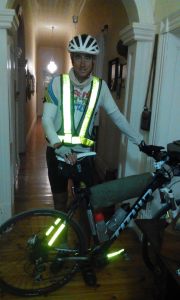
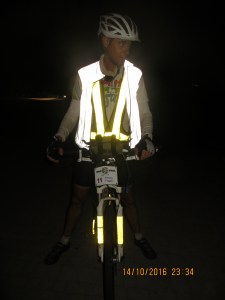
  3. Clothing. Once I got a reflective vest and added a high visibility Gillet to it, I became a light post. Far to many cyclist where black. Yes, most bibs come in black. However a high visibility shirt or jacket in a colour like yellow and green or even white can make you more visible in the day.
  4. Tail lights. A good bright red flashing tail light catches a lot of attention. There are some countries that do not allow this. Then try using a solid red light. I have had my batteries go flat and not get the right batteries in small towns far away from the maddening crowds. Carry spares or use batteries that are more readily available. The other option would be to link them up to your dynamo. To make sure that there are no failures. I think it is good to have two red tail lights on the back of your bike. I have also seen people wearing red tail lights on the back of their helmet.
  5. Front head lights. I good front light lets the on coming traffic know you are there. However this can blind them if to strong. Try to get a light that has a dim function, same as cars have. Remember you need to see where you are going or that could mean the end for you. There have been many a cyclist that have ridden into things and off things in the dark. A head lamp can also help to see around corners and check what is going on with the bike.
  6. When doing enduro racing. The lack of sleep can become very dangerous. I have had times when I fell asleep going down a hill. Lucky I did not ramp off the side of the road. You can also wobble in front of traffic. Your time to react is also very slow. Best solution is to make sure you have at least 4 to 6 hours sleep depending on what your body tells you. If you are feeling drowsy get off and go have a cat nap. Do not fool your self that you have had a good sleep when camping out on top of rocky lumpy pieces of ground.
  7. Risk of been attacked. I recommend not showing off your high end bike. Do not load to many expensive looking gadget on the handle bars. Do not flash money around. Rather have a few small notes in a pocket which are easy to pull out. Then hide the other money in a safe place and fill up the pocket when nobody is around. If camping out wait until the sun has set and find a well hidden site. Best in a bush thicket or behind a hill or dirt bump so lights do not find you from the road. If you are unsure of the safety in a area head for a camp ground.


Hope these few pointers will help you keep safe.

Bicycle set up

This is another over spoken topic on cycling long distances. Let me throw in my uneducated opinion.

When I was young I just jumped on any bike and started peddling. I remember riding my Dads 29er single speed with a big dynamo light on the front, when I was 7 years old. That meant I could not sit on the saddle and had to slide over the bar from side to side to peddle. That got me to my friends house and the shop. Then it was my brothers bike and he was five years older than me. Nice little 24er single speed which was very responsive. Then I got my first bike which was a road bike with 10 gears. In today’s terms we might refer to it as a gravel bike. This thing went any place dirt track, ramping and tarmac. It was a 26er Raleih and I was eleven so I had to grow into the bike.

So bike setup was not high on my priority list as most bikes did not fit me. Those days I never got back ache, numb fingers, numb toes, neck pains and sore knees. Having said that when you are young you are very rubbery and flexible. As time goes on and you get a little older these things start to become a problem.

When I did my first tour of Zimbabwe and Mozambique I discovered some of these wonderful feelings. That bike was a 26er and a little small for me. The numb toes and bloody knees from falling in the road were new experiences for me. This was also the first time I had ridden with cleats. This new scientific development in my riding gear had started me on a whole new way of looking at what relay happens when riding.

Lets touch on a few important points. My brother in law Casper Bardenhorst a Top South African MTB rider said ”Where you come into contact with the bike is where you should pay the most attention”. So I will break this into: Handle bars, peddles and saddle.

Handle bars

I will not tell you what is best for tour or endurance racing. I feel each rider must get up on his faithful steed and see what makes him comfortable. Also what comforts he is willing to sacrifice for speed or heavy load of luggage. Things to look at are the height of the handle bars to the saddle. Remember racing road bikes have a rule that bars are below the saddle to get a more aerodynamic position. This can cause back pain if remaining in this position for a long time. The older you get the less flexible you become thus as you get older it is better to start raising the handle bars. There is a price to be paid with more wind resistance. I believe you ride to enjoy riding. Remember when there is more body weight pressing down on your hands there is also more pressure on the nerves in your wrists. This can cause numb fingers.

Hand position is important. I have put grips on to force me to keep my wrist straight to take pressure off the nerves in the wrist. I tend to be lazy and bend my wrists. This also means the brakes and gear leavers need to be in position so that you do not have to bend wrist or move hand around to operate them. Then there is the selection of handle bars. For racing and smooth gravel drop bars are often preferred. They give you more hand positions and less wind resistance. MTB flat bars can have bar ends added to give more hand positions. Tri bars can be added to take weight off hands and better aerodynamics. They also give you more hand positions.


A good pair of gloves with a gel pad can take some of the vibrations off the hands. Then there is also a need for good winter gloves. Or water proof gloves as there can be quite a wind chill in the wet weather.

Saddle

Probably the most important is to select a saddle that is designed for your sex and body weight. Woman have wider pelvic bones thus need a slightly wider saddle than men. This makes sure the pressure is placed on the right place on the tender parts. There are saddles with groves and spaces in the middle which supposed to reduce pressure on the prostrate. I cannot tell you what I think as I have never used one. There are leather and synthetic saddles. I do not care which one. Just do not try to save pennies as it could cost you lots of pain. I landed a Giro italia on a 50% off sale and that was one of my best things I did to my cycling comfort. So if you go cheap look for a saddle that is high end and wait for a special. There is lots of talk about Brooks saddles. However last time I rode one was when I was a child. These leather saddles can take your body shape and be adjusted to fit you.

Remember those terrible cycling bibs. I thought men look discussing in them. Turns out women like looking at men with them on. I even said ”you would never find me wearing one”. Well I now wear them and enjoy my cycling far more. These need to fit tight to keep the pad in the right place. If the pad moves around you will get saddle sores. Longer rides need better quality shorts. They can be very pricey so read a lot of reviews before purchasing. I read a review that compared imported and locally made. The review gave each a score of 1(bad) to 10 (Very good). I found they had a review of a bib that got a 7 out of 10 that was locally made and it had a higher score than some imported bibs. So I ordered over the internet two from Enjoy fitness in Cape town. Then when I wrote to the company after I finished my first Trans Afrika and thanked them for a saddle sore free race of 2800 km. They wrote back and thanked me and gave me a bib of one grade better plus a cycling shirt with the South African flag on it for free. So when I rode my second Trans Afrika I rode in their bib and shirt. It was even more comfortable.


Remember the saddle setup is also of importance. I have read a lot of things about saddle setup. They talk of all sorts of measurements. So to get your saddle close to right position put a level on it. Then sit on it to feel what it feels like as each manufacturer has slightly different shapes that press on different parts of the tender areas. Then the rail under the saddle can move the saddle closer or further from the handle bars. Remember the best fit should be done by a professional. Height of saddle can be done by getting a formula off the internet and measuring from your groin to the floor when standing. After doing this get on your bike and ride. To high and to low makes your knees pain. So even if you have done the measurements you will have to adjust a little up or down. When you change your bib and shoes that will also change the height of the saddle.

Peddles

Here you can select from flat to cleats. Some people find on long rides their toes get numb.Now you need to find out why this happens.

Flat peddles are handy for if you are ridding steep hills and need to hike a bike up a mountain or put your foot down fast and often. If you are going to slow up the hill it might just be easier to get off and push or carry the bike. Then a good pair of walking shoes will help. The other choice is the older you get the easier you tend to fall and a broken hip or shoulder blade does not mend to easy. My boss now uses flats after he fell with cleats at the age of 60 and had to have a hip replacement. He has not stopped riding.

Cleats are another whole science. Lets put it this way I like them because on bumpy roads my feet do not slip off the peddles. When you need a little more boost you can press down and pull up. When on a long ride and the muscles get like they do not want to work anymore you can change your muscles that are doing the work, by let them rest. You can pull or slide your foot in a different way and change out the muscles that are working. Remember on short rides you can use your normal shoe size. On long rides the foot swells from the muscles working out and can slow the circulation in the foot if shoe is to small.

Socks are also very important. Winter socks warm you up and summer they over heats your feet. These can also be one of the best investments for a pleasurable ride. I have used plastic bags on the feet to stop the wind chili in winters mornings and take the bags off in the heat of the day. That way you do not have to carry lots of luggage.

Well this turned into a monster read with very little facts. What works for one person may not work for another. I just tried to give you a vision of what may help.