Following Annabelle’s African Bicycle Adventure – And Rethinking Belt Drives

Over the past few months I have been following a cyclist on TikTok called Annabelle 🙂. She and her boyfriend, who are from the USA, have ridden their bicycles all the way from Europe down the eastern side of Africa. They have now reached South Africa and are closing in on Cape Town.

It has been fascinating to follow their journey. Like many long-distance cyclists in Africa, they have faced far more than just long days in the saddle. Visa bureaucracy has caused some significant delays along the way, and in several countries they had to arrange for spare parts and visas to be sent ahead. Even something as simple as collecting a package became an adventure in itself.

Now they are riding through South Africa during winter. Although many people think of Africa as always being warm, this time of year can be surprisingly cold. In the mountains they could even encounter snow. Fortunately, by staying closer to the west coast they seem to have avoided the worst of the winter weather so far.

One recent problem really caught my attention. Annabelle’s bicycle is fitted with a belt drive instead of the traditional chain, and unfortunately the belt has broken.

That immediately made me stop and think.

For years I have read how reliable belt drive systems are supposed to be. Many cyclists praise them as the ultimate low-maintenance solution. They don’t need lubrication, they aren’t affected by muddy conditions in the same way as a chain, and without oily lubricant they don’t attract dust and grit. I’ve even read reports from riders who have covered tens of thousands of miles without replacing a belt.

I have often thought about converting to a belt drive with an internal gear system. On paper it sounds ideal for African travel. No oily chain to clean, less wear from sand and dust, and far less routine maintenance.

But watching Annabelle’s experience has reminded me that every system has its weaknesses.

If a chain breaks almost anywhere in Africa, there is a reasonable chance that you can repair it or find a replacement. A broken belt is a very different story. In South Africa you can probably find one in the larger cities, but once you head into remote regions the chances become much slimmer. Reliability is wonderful—until the one time something does fail.

It also reminded me of my own first bicycle tour through Africa.

Before leaving I had my bicycle serviced, thinking everything would be perfect. Instead, the shop fitted a new chain onto a badly worn front chainring. The worn teeth caused the chain to catch constantly. In Harare in Zimbabwe, I had to find a bicycle shop to help sort it out.

Even then, it wasn’t an instant fix. For around 500 kilometers after leaving Harare the new chain and chainring had to gradually wear together before everything finally settled down. It was simply a matter of letting the chain and chainring “marry” each other.

Little mechanical problems like that can take the shine off an otherwise incredible journey.

Watching Annabelle’s travels has reminded me that bicycle touring is never just about the riding. It’s about adapting to the unexpected, solving problems, and continuing despite the setbacks. Those are often the stories we remember most.

I’m still attracted to the idea of a belt drive and internal gear system, but now I’m asking myself whether the reduced maintenance is worth the potential difficulty of finding replacement parts in remote areas.

I’d love to hear from readers who have experience with belt drive touring bikes.

  • Have you toured long distances with a belt drive?
  • Have you ever had one fail?
  • Would you choose a belt drive over a traditional chain for an extended African expedition?

Please leave a comment below and share your experiences.

I’ll also include a link to Annabelle’s TikTok account so you can follow the final stages of their remarkable journey to Cape Town.
Cycling in Africa: A Night Ride and Village Welcome in Mozambique

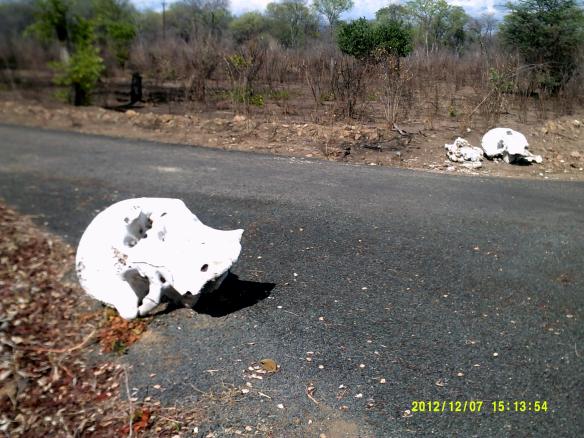
I was riding my bicycle through the African savannah as the sun hit the horizon when a thought hit me that made the road ahead feel a lot longer — my small headlamp wasn’t strong enough to spot elephants in time if they were standing on the road. Earlier that day I had already passed two elephant skulls and several piles of dung. Now the night was closing in fast.

Elephant skulls

Long-distance cycling in Africa always comes with a sense of adventure and the unexpected. While riding my bicycle from Mague to Estima in Mozambique, I experienced one of those nights that perfectly captures what bicycle touring across Africa can be like.

The road stretched out in front of me — a good tar road cutting through the wide African savannah. But I was starting to worry about where I would camp for the night.

This region had once been part of the Mozambican civil war, and I knew landmines had been planted in areas not far from the road. Camping randomly along the roadside didn’t feel like a good idea.

Cycling into the African Night

The sun slowly dipped below the horizon and soon disappeared completely. One by one the stars came out, leaving me riding through the savannah with only a small head headlamp lighting the way.

From past experience cycling in Africa, I knew that light wouldn’t give me enough time to identify elephants on the road ahead. At night, elephants often blend into the darkness. With a spotlight they simply look like part of the night itself.

That meant there was a real possibility of riding straight into a herd before realizing what was happening — something no cyclist wants to experience.

Finding a Village in Mozambique

Around 8 p.m., I finally came across a small tribal village and decided to stop and ask if I could camp there for the night.

As I stopped, I promptly fell off my bicycle when my cleat refused to disengage — not the most impressive entrance into the village.

An older man saw the whole thing. We tried to communicate, but neither of us understood the other. He called over a younger man who, fortunately for me, had spent time working in Zimbabwe and spoke some English.

I explained that I was cycling across Mozambique and asked if I could camp in the village.

The answer was respectful but not simple.

They told me they didn’t have permission to allow it. I would need to speak to the night watch — the man responsible for keeping elephants out of the farmland at night.

Asking the Village Elder

We found the night watch, and after listening to my story he explained that he also didn’t have the authority to allow it. Only the village elder could make that decision.

So we walked to the elder’s house.

He wasn’t there at the time and was visiting somewhere else in the village, so we waited outside. About fifteen minutes later he returned.

When he arrived, my translator bowed down, making sure his head stayed lower than the elder’s chin — a sign of respect still practiced in the village. Seeing that in today’s modern world was fascinating, and I wasn’t quite sure if I should be doing the same.

The elder listened carefully to my story about cycling across Africa and looking for a safe place to camp.

Then he smiled and immediately offered a place right beside his house.

Camping in an African Village

I thanked him and set up my tent near his home. The elder then asked through the translator if I needed food. I told him I had brought some with me, so I cooked a simple meal of instant noodles.

Later that evening I sat under the trees near his house where several elders of the village were gathered talking quietly in the dark. I didn’t understand their language, but it was still a special moment to sit there and share the night air with them.

Eventually I excused myself and crawled into my tent. Not knowing how safe my bicycle would be, I pulled it inside the tent with me — which made for a tight fit in a two-man tent.

Sunrise in the Village

Just before sunrise the roosters began crowing and the village slowly came alive with the sounds of morning.

I packed my gear back onto the bicycle and waited for my translator, who had said he would come by in the morning.

Soon the elder stepped out of his house. I asked the translator to thank him again for his hospitality. Once again, the young man bowed respectfully as he spoke.

Then I climbed onto my bicycle and rode out of the village as the sun rose like a glowing ball on the horizon.

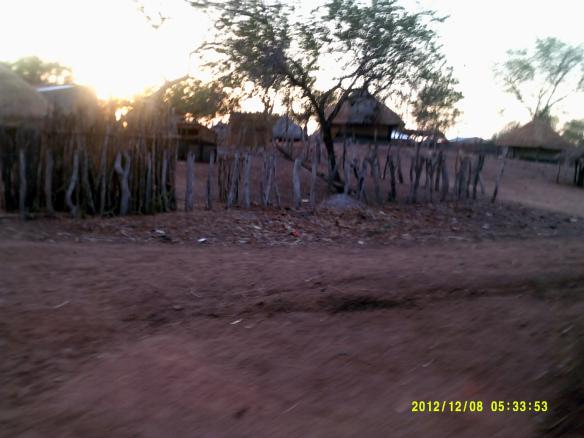
In the daylight I could finally see the village clearly — round mud houses with thatched roofs, dusty ground with chickens wandering everywhere, and the African savannah stretching beyond it.

And just like that, my Mozambique cycling adventure continued down the road toward Estima.

Sun rise village