Following Annabelle’s African Bicycle Adventure – And Rethinking Belt Drives

Over the past few months I have been following a cyclist on TikTok called Annabelle 🙂. She and her boyfriend, who are from the USA, have ridden their bicycles all the way from Europe down the eastern side of Africa. They have now reached South Africa and are closing in on Cape Town.

It has been fascinating to follow their journey. Like many long-distance cyclists in Africa, they have faced far more than just long days in the saddle. Visa bureaucracy has caused some significant delays along the way, and in several countries they had to arrange for spare parts and visas to be sent ahead. Even something as simple as collecting a package became an adventure in itself.

Now they are riding through South Africa during winter. Although many people think of Africa as always being warm, this time of year can be surprisingly cold. In the mountains they could even encounter snow. Fortunately, by staying closer to the west coast they seem to have avoided the worst of the winter weather so far.

One recent problem really caught my attention. Annabelle’s bicycle is fitted with a belt drive instead of the traditional chain, and unfortunately the belt has broken.

That immediately made me stop and think.

For years I have read how reliable belt drive systems are supposed to be. Many cyclists praise them as the ultimate low-maintenance solution. They don’t need lubrication, they aren’t affected by muddy conditions in the same way as a chain, and without oily lubricant they don’t attract dust and grit. I’ve even read reports from riders who have covered tens of thousands of miles without replacing a belt.

I have often thought about converting to a belt drive with an internal gear system. On paper it sounds ideal for African travel. No oily chain to clean, less wear from sand and dust, and far less routine maintenance.

But watching Annabelle’s experience has reminded me that every system has its weaknesses.

If a chain breaks almost anywhere in Africa, there is a reasonable chance that you can repair it or find a replacement. A broken belt is a very different story. In South Africa you can probably find one in the larger cities, but once you head into remote regions the chances become much slimmer. Reliability is wonderful—until the one time something does fail.

It also reminded me of my own first bicycle tour through Africa.

Before leaving I had my bicycle serviced, thinking everything would be perfect. Instead, the shop fitted a new chain onto a badly worn front chainring. The worn teeth caused the chain to catch constantly. In Harare in Zimbabwe, I had to find a bicycle shop to help sort it out.

Even then, it wasn’t an instant fix. For around 500 kilometers after leaving Harare the new chain and chainring had to gradually wear together before everything finally settled down. It was simply a matter of letting the chain and chainring “marry” each other.

Little mechanical problems like that can take the shine off an otherwise incredible journey.

Watching Annabelle’s travels has reminded me that bicycle touring is never just about the riding. It’s about adapting to the unexpected, solving problems, and continuing despite the setbacks. Those are often the stories we remember most.

I’m still attracted to the idea of a belt drive and internal gear system, but now I’m asking myself whether the reduced maintenance is worth the potential difficulty of finding replacement parts in remote areas.

I’d love to hear from readers who have experience with belt drive touring bikes.

  • Have you toured long distances with a belt drive?
  • Have you ever had one fail?
  • Would you choose a belt drive over a traditional chain for an extended African expedition?

Please leave a comment below and share your experiences.

I’ll also include a link to Annabelle’s TikTok account so you can follow the final stages of their remarkable journey to Cape Town.

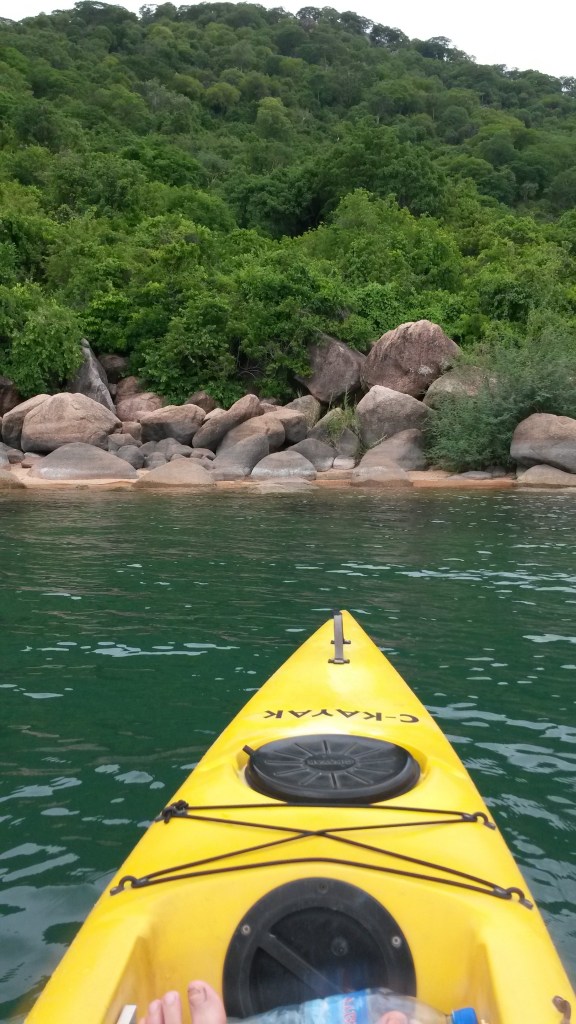
Kayaking to Domwe Island, Lake Malawi in Great Rift Valley/ An Unforgettable Malawi Adventure

What would you do if you had to paddle across one of Africa’s deepest lakes, knowing the dark water beneath you drops hundreds of metres into the Great Rift Valley?

That was the challenge I faced when I decided to kayak from Kayak Africa to Domwe Island on Lake Malawi (also known as Lake Niassa). It became one of those travel experiences that pushed me beyond my comfort zone and reminded me that the best adventures often begin with a little uncertainty.

Before setting off, the team at Kayak Africa explained that everyone paddling to the island must be accompanied by a guide. The lake conditions can change quickly, and they want to ensure every guest arrives safely. We left early in the morning, taking advantage of the calm morning before the wind had a chance to build.

Thumbi west Island Infront Kayak Africa lodge with Domwe Island just out view on the right.

Although I’d kayaked before, I certainly wouldn’t call myself experienced. As I climbed into the kayak, it felt surprisingly wobbly, and I wondered if I’d made the right decision. But there was no turning back now.

From the shore, Mumbo Island looked deceptively close. Once you’re relying entirely on your own muscles to get there, however, the distance seems to stretch endlessly across the water.

About halfway through the crossing, my shoulders were burning. Every paddle stroke reminded me of muscles that clearly hadn’t been used for this kind of workout in a long time.

Then something unexpected happened.

The water beneath me changed from a light blue to an incredibly dark blue-green. Instantly, my imagination took over.

Lake Malawi sits within the Great Rift Valley, where the African continent is slowly pulling apart. Over millions of years, enormous rift lakes formed here, creating incredible depths. Technical scuba divers travel from around the world to explore these deep waters because they offer exceptional diving conditions without the powerful currents found in the ocean.

Some view from the kayak.

Knowing just how deep the lake was made me wonder what might be lurking below.

Of course, there were no monsters beneath me—but my imagination painted a different picture. Every glance into the dark water made it feel as though some giant creature could emerge from the depths at any moment.

To quiet those thoughts, I fixed my eyes firmly on the beach ahead. One paddle stroke after another.

The beach where I landed at Domwe Island with the dining room deck showing.

As the crossing progressed, the wind began to pick up. Soon small whitecaps formed across the lake, and the waves reached around two feet high. The kayak rose and dipped over each swell, its bow slicing through the water. They weren’t ocean-sized waves, but for someone with limited kayaking experience, they certainly commanded respect.

Meanwhile, my guide paddled calmly beside me, making it all look effortless.

Eventually, the shoreline grew larger, and before long my kayak scraped gently onto the beach.

I climbed out feeling exhausted, relieved—and incredibly proud.

My kayak with guides kayak and another person stopping by to check if lodge needs help.

Sometimes the greatest part of an adventure isn’t reaching the destination. It’s discovering that you’re capable of much more than you first believed.

If you’re looking for an unforgettable experience in Malawi, kayaking across Lake Malawi to Domwe Island or other islands can be one I can wholeheartedly recommend. It’s physically challenging, mentally rewarding, and offers a unique perspective on one of Africa’s most spectacular lakes.

Want more real travel adventures like this?

Download my ebook and discover the stories, lessons, and unforgettable experiences from my bicycle journeys across Africa. If you enjoy authentic adventure travel, practical tips, and moments that push you beyond your comfort zone, you’ll love what’s inside. My ebook Run away to Africa by Kenneth Fagan on Amazon. There is a link in the shop page. If you want to book accommodation on an island https//kayakafrica.co.za can be found on Google.

Untold Stories from Malawi

Over the past few weeks, I’ve been working on my next book, Run Away to Malawi. I’m about halfway through the manuscript, and one thing has surprised me.

As I revisit my journals and photographs, I’ve realized just how many stories never made it onto my blog. There are dozens of moments from the journey that were never fully told. Some photographs appeared in the sidebar of Longdaysafaris.com with little or no explanation, but every one of them has a story behind it.

One memory that found its way into the book was a conversation with a cyclist I met along the road in Malawi.

His bicycle wasn’t loaded with camping gear like mine. Instead, it was piled high with supplies. He explained that he owned three small shops in different villages. Rather than sitting behind a counter, he spent his days riding from village to village delivering stock. He employed people to run the shops while he managed the business from the saddle of his bicycle.

His main products were simple essentials: sugar, flour, and coffee. Items that every family needed.

Another detail I had forgotten was what happened when you bought a bottle of soda. You couldn’t simply walk away with it. The bottle had value. You drank your soda at the shop and returned the empty bottle so it could be sent back for a deposit.

Digital Camera

That also explained something I noticed throughout my journey.

The children who ran out to greet me weren’t just waving. Many would ask if I had any empty bottles. To them, those bottles were useful. They carried drinking water to the fields, stored drinking water at home, and found countless ways to reuse them.

Very little went to waste.

In many of the rural villages, there was almost no litter. Things were repaired, reused, repurposed, or eventually burned. Nothing was thrown away simply because it was old.

These are the kinds of stories that don’t always fit into a daily travel blog, but together they paint a richer picture of life in Malawi.

I’m looking forward to sharing many more of these moments in Run Away to Malawi. I think you’ll discover that the journey was about far more than cycling from one place to another—it was about the people, their ingenuity, and the lessons they unknowingly taught me along the way.

Digital Camera