Every long-distance cyclist knows the feeling. You’re on a quiet dirt road in the middle of nowhere, no town for miles, and your bike makes a new sound. Your ears lock onto it. Every pedal stroke, you listen. Is it nothing? Or is it the start of a long walk?
Fresh From the Shop, Silent as a Ghost
When I send the bike in for a service, it comes back quiet. It’s a beautiful thing. Then I get a few miles down a dirt road, the dust and vibration go to work, and the first noise shows up. It’s like the bike wants to remind me who’s in charge.
The Bottom Bracket
When I started long distances, a squeaking bottom bracket started at 200 miles. Every turn of the crank, another squeak. I swapped it for a Shimano and got far more miles out of it before it complained again. Bike shop was putting in cheap parts. I now go with Shimano middle of the range. Good lesson to remember.
Steel on Steel: The Pedal Squeak
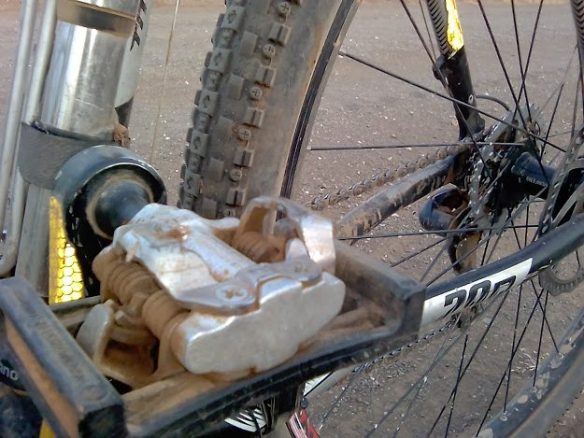
Next came the pedals. The culprit is the cleat, steel against a steel pedal, and metal rubbing on metal will always sing about it. The fix is easy: a small dab of Vaseline or a drop of chain lube on the cleat, and the squeak goes away.
The Saddle
Then the saddle started up. I replaced it and the noise stopped. Now, after more than 10,000 miles on my current saddle, it’s squeaking again. When I looked closer I found the saddle rail has separated at the joint on the flat section where it clamps to the seatpost. That’s not a noise to lube and ignore. A cracked rail can let go without warning, so that saddle’s days are numbered, and I’m not going to push my luck on a remote road.
First saddle did about 10000 miles.
The Headset
Now it’s the bearings at the handlebars. I had to look this one up: it’s called the headset, the bearings that let your fork turn in the frame. The cure is the same as always. Strip it down, clean out all the dust and grit, and add fresh grease.
The Chain and Drivetrain
Then comes the day the chain tells you it’s had enough. It’s time to clean off the old, grimy lube and start fresh. Wait too long and the gears get lazy about shifting, and you’ll hear a tick from down at the derailleur or the little jockey wheels. A clean chain and a little lube usually settle it.
What the Noises Are Really Telling Us
A bike is a conversation. The squeaks and ticks are how it asks for attention, and most of the time the answer is simple: clean it, lube it, tighten it. Learn what each sound means and the fear goes away. That makes it a lot easier to enjoy the quiet, dusty road, right up until the next noise.
What sounds have followed you down the road? Tell me in the comments.
I add a video of my ride this weekend. See if you can hear the sound and tell me what it is.
A while back I posted a video on YouTube with a simple title: crazy people ride their bicycles. It got a lot of views, more than I expected. It got me thinking about who was watching and what they thought of us. Here is the video.
I have a pretty good guess about what professional road cyclists think of people like me: hairy, unwashed, and a little bit lost. And honestly? They might be right.
Life at Walking Speed (Almost)
When you cross a country at 6 or 10 miles an hour, the world looks different. You notice the change in the soil, the smell of the bakery in a village you’d have missed at 30 mph, and the old man who waves you over to talk. You also don’t always find a shower. Sometimes you don’t find water for a good stretch. That’s part of the price, and it’s a price I’m happy to pay for crossing countries and learning from the locals.
Packing Light, Thinking Hard
The less you carry, the better the trip. Every extra pound is a pound you push up every hill. So you start asking yourself the hard questions: is this a need, or is this a want? A second pair of shoes? A want. A spare tube? A need. Long-distance touring is the best lesson in minimalism I’ve ever had, and it’s cheaper than therapy.
About Those Hairy Legs
Road cyclists will tell you that leg hair creates wind resistance, and for someone chasing seconds in a race, fair enough. But I’m hauling bags up a mountain pass, and I’ll take my chances.
They also say that when you crash, the scabs form in the hair and injury treatment becomes problem. I say we’ve all fallen off a bike, and a scab is a scab. Nobody ever finished a tour without a few of them.
And consider what the hair gives us in return:
Winter warmth. Legs and face both get a little extra insulation on those cold mornings on the road.
Sun protection. Ever thought about sunburn? A bit of hair is a bit of shade. Not a replacement for sunscreen, but it’s not nothing.
The Dad Belly Aero Theory
I also read an article claiming a dad belly helps with wind resistance, rounding off the front of the body so the wind passes smoothly around the hips. Now, I’m not saying the science is settled, but I am saying some road cyclists might have something to learn from the rest of us. Maybe the secret to going fast was the extra helping of dessert all along.
So, What’s the Verdict?
Pro cyclists have their world: shaved legs, tight kits, and precision. We have ours: slow miles, good stories, and dirt in places I won’t mention. Neither is wrong. But I know which one I’d rather be riding through a foreign village at sunset.
Have you ever ridden a long distance? Are you a shaver or a natural? Tell me in the comments.
Disclaimer this is the real facts:
I must admit I did bend some of the facts.
Leg hair and aero: Wind tunnel tests do suggest shaving saves a small amount, but it only matters over a race. For a loaded touring bike, your bags and your body position matter far more.
Scabs and healing: The real reason roadies shave is that road rash is easier to clean and dress on smooth skin. Hair doesn’t seriously hurt healing.
Warmth and sun: Leg hair adds only a little protection and warmth. Sunscreen is still your best friend out there. Long sleeves and full-length bibs offer even more protection and aerodynamic help.
Dad belly: I kept it as a joke. A round belly probably doesn’t help much, but readers enjoy the theory, and my self-deprecating humor is part of the blog.
I visited a Specialized bicycle shop this week, and it got me thinking about bicycles.
Not just about the bicycles hanging on the racks, but about what I actually want from a bicycle.
I also stopped at a large outdoor and sporting goods retailer. The contrast between the two stores was interesting.
The large retail store had plenty of bicycles, but they were mostly mass-produced machines aimed at the general consumer. Looking at some of them, I wondered how well some of the components, particularly the bearings, would hold up to the sort of riding I like to do.
The cycling clothing selection was also limited. There were cycling jerseys and shorts, but I couldn’t find a pair of proper cycling bibs.
If you’ve spent several hours in the saddle, you understand why that matters.
There is cycling clothing, and then there is clothing designed to make riding a bicycle for hours more comfortable. For someone planning a long-distance ride, comfort and durability aren’t luxuries. They become necessities.
The outdoor store did have another side to it that I found interesting. There were plenty of camping gadgets and pieces of equipment that could make life on the road a little more comfortable. Some of those things caught my attention and got me thinking about what I might take on a longer bicycle tour.
But it was the Specialized shop that really got me thinking about bicycles.
Looking at the High-End Bicycles
Specialized is one of the well-known, respected bicycle brands, and it is easy to see why when you walk into one of their stores.
There were bicycles that weighed a fraction of what my current bicycle weighs. They had lightweight components, alloy and carbon-fiber construction, aerodynamic frames, fancy wheels and spokes, and all sorts of technology designed to make the bicycle faster and more efficient.
They were beautiful bicycles.
And I can certainly understand why someone would want one.
As I looked along the racks, though, my eye eventually landed on something that perhaps wouldn’t have made a salesperson quite as excited.
It was the cheapest bicycle on the rack.
It was around $1,200.
And I liked it.
Not because it had the most technology.
Actually, quite the opposite.
It was straightforward.
It had a simple alloy frame, mounting points for panniers and water bottles, and a relatively uncomplicated drivetrain with one front chainring. There were no bells and whistles that I didn’t think I needed.
Most importantly, it weighed about half as much as my current bicycle.
That caught my attention.
The model was the Specialized Sirrus 3.
Now, before anyone thinks this is a criticism of Specialized, it isn’t.
Specialized has designed the Sirrus 3 for a purpose. It is an urban and fitness bicycle, not a gravel touring bicycle. The narrower tires and its overall setup make sense for what the bike was designed to do.
What I started doing was imagining what I could make of the basic bicycle.
What Would I Change?
If I bought the Sirrus 3, I wouldn’t leave it exactly as it came from the shop.
I’d personalize it.
The first thing I’d look at would be the handlebars.
I’d put drop bars on it, giving me more hand positions and making it better suited to the sort of longer-distance riding I enjoy. I’d also want a stem that is high enough to give me a comfortable riding position.
One thing I’ve learned from riding is that being stretched out too far or having the handlebars too low can become very uncomfortable after several hours.
I’d also like the ability to fit aerobars.
For shorter fitness rides, I might not need them. But when you’re riding for hours, being able to change your position can make a big difference.
I’d want pedals that could accommodate cleats but also give me the option of riding with flat shoes.
Then there are the tires.
The Sirrus 3 comes with narrower tires because it was designed primarily for urban riding and paved surfaces. If I were going to use it mainly for riding on good roads, I’d probably leave the tires alone.
But my idea is something more versatile.
I’d like the ability to run tires somewhere between about one and two inches wide, preferably tubeless, depending on where I planned to ride.
The salesperson actually mentioned that Specialized is looking at bringing out a version with larger tires, which makes sense as more riders look for bicycles that can move between pavement, gravel and other surfaces.
For the kind of touring I have in mind, wider tires would give me more options.
Gearing Would Depend on the Ride
The bicycle I looked at had one front chainring.
I actually like the simplicity of that.
There is one less component to maintain and one less thing to go wrong.
But I might eventually change that.
I would want enough gearing to give me a good top speed on flat roads while also giving me a low enough gear to climb hills when the bicycle is loaded with panniers.
Whether I really needed two chainrings would depend on experience.
I’d have to load the bicycle up and ride some hills first.
That’s one of the lessons I’ve learned from cycling: what looks good on paper doesn’t always tell you what you need when you’re actually riding.
My Ideal Touring Bicycle
All of this got me thinking.
If I could design a bicycle specifically for myself—something that I could use for fitness riding around my neighborhood, but also take on a long-distance bicycle tour—what would it look like?
My list would be something like this:
Lightweight, but available in an XL frame to suit a tall rider
Drop handlebars
A higher stem for a more comfortable, upright position
The ability to fit aerobars
Pedals that can accommodate cleats and flat shoes
Mounting points for panniers
Mounting points for water bottles and other equipment
Front suspension or a fork capable of handling rougher surfaces
A useful range of gears for both speed on the flats and climbing hills
Hydraulic disc brakes
29-inch wheels
Tubeless tires with a useful range of widths, approximately 1 to 2 inches
A comfortable saddle that properly supports the sit bones
A dynamo hub
An electrical system for lights and charging equipment
Front and rear lights
Manual shifters
Easily removable wheels, preferably with skewers or another simple release system
Reflective tape on the front and rear forks
A well-sealed bottom bracket bearing that is easy to replace
It sounds like a long list.
But after years of riding, I don’t think I’m looking for a bicycle with every possible feature.
I’m looking for a bicycle that gets the important things right.
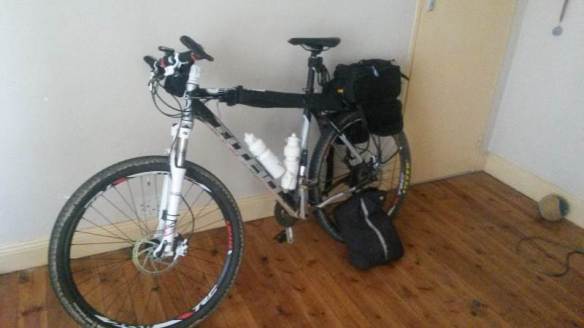
Setup for my first Trans Africa race
Comfort, Durability and the Freedom to Ride
For me, it comes down to three things:
Comfort. Durability. Longevity.
I want a bicycle light enough that riding it is enjoyable.
I want it comfortable enough that I can spend hours in the saddle without constantly thinking about the bicycle.
I want it strong enough to carry the equipment I need for a longer trip.
And I want components that are durable, serviceable and relatively simple.
There is something appealing about simplicity.
Every additional component can have a purpose, but every additional component can also become something that needs adjustment, maintenance or replacement.
That doesn’t mean I don’t appreciate high-end bicycles.
Quite the opposite.
Standing in the Specialized shop and looking at those incredibly light machines was impressive. The engineering, materials and technology that go into modern bicycles are remarkable.
But a bicycle designed to win a race isn’t necessarily the bicycle I want to take across the country.
I’m looking for something somewhere between a fitness bicycle, mountain bike, a gravel bicycle and a touring bicycle.
Something I can ride hard on a paved road when I want to put some speed into the ride.
Something I can take onto gravel when the road disappears.
Something that can carry panniers when I decide to disappear for a few days.
And something that I can maintain without needing a degree in bicycle engineering.
Perhaps that’s what comes with riding for a long time.
When you first start cycling, you might look at a bicycle and ask:
“How fast is it?”
After enough miles, you start asking different questions.
“How comfortable is it?”
“How long will it last?”
“What happens when I put 30 or 40 pounds of gear on it?”
“Can I fix it when I’m 100’s of miles from the nearest bicycle shop?”
And perhaps most importantly:
“Will I enjoy riding it?”
That’s the bicycle I’m looking for.
Not necessarily the most expensive one.
Not necessarily the lightest one.
Just the right one for the ride I want to take.
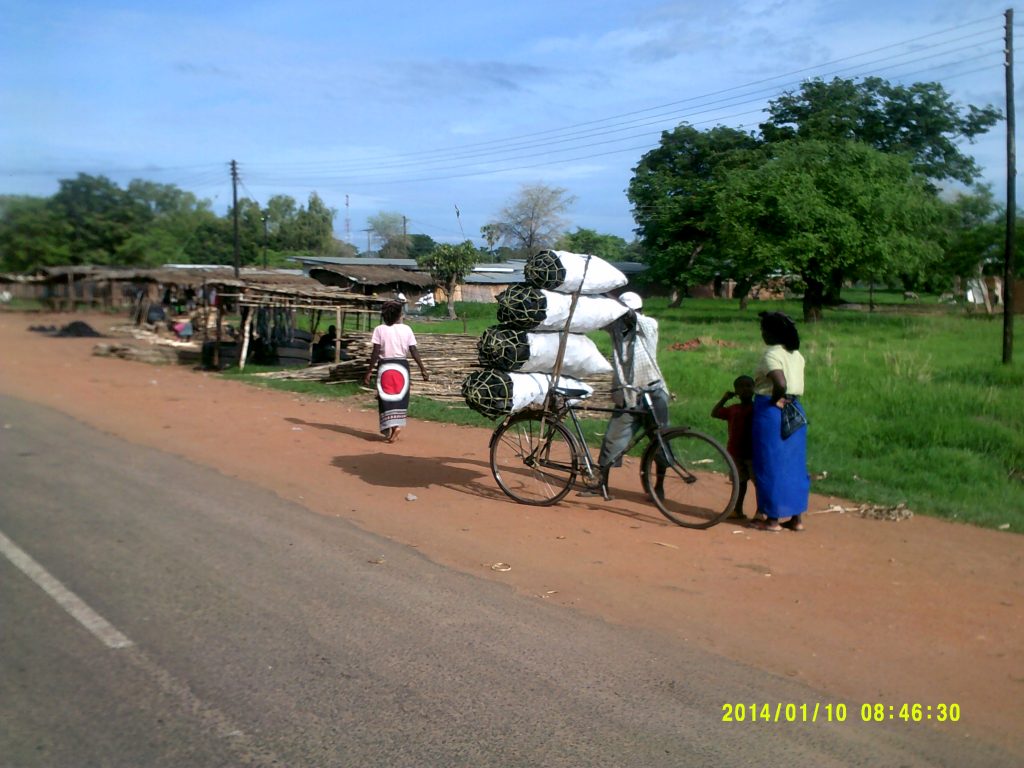
Common bicycle in Africa. This one transporting charcoal.
What would you build or like to be on your bicycle? Write in the bubble at top of post.
I made a short video to let you feel some of the adventures that I have had. Well I see it would be far better to write a book or sit and have short videos of some of the best stories. I am currently editing my first book. Looks like it should be finished by the end of the year. Take a look at this video. Hope you feel some of the excitement I felt when tour cycling.
You could join me along the road and make your own stories.